

The only such resource available today!!
- Motor Carrier Contracts Annotated, Third Edition is a contract form book with four complete contract templates designed for easy use by shippers and their attorneys.
- This new edition of Motor Carrier Contracts Annotated thoroughly updates previous editions to be in accord with current industry practices and applicable law.
The provisions relating to insurance have been extensively revised to reflect the new risks created as a result of the explosion of strategic cargo theft in what is known as the Fraudemic.
- The four contract templates include optional provisions with comments and instructions on how to use allowing the user to tailor the contracts for individual clients or situations.
The provisions relating to insurance have been extensively revised to reflect the new risks created as a result of the explosion of strategic cargo theft in what is known as the Fraudemic.
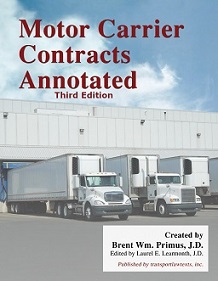

Why spend valuable time and money to “reinvent the wheel”?
All this for $295!
Overview of Motor Carrier Contracting:
A motor carrier’s Bill of Lading typically incorporates by reference the carrier’s Terms and Conditions which are drafted by the carrier and in favor of the carrier. An individually negotiated contract such as those in this text allows the shipper to “contract away” from one-sided, and often onerous, Terms and Conditions drafted by the carrier.
Prior to 1980, virtually all transportation provided by motor carriers moved according to the terms and conditions of the Uniform Bill of Lading as contained in the National Motor Freight Classification. This is why the Bill of Lading was often referred to as the “contract for carriage.”
NEW! Shipper-Provider Contract Template.
As MAP-21 went into effect and the industry became aware of it, large, national transportation providers would add language into the shipper-carrier contract saying, “We reserve the right to use our brokerage authority for the shipments tendered to us pursuant to this contract.” While this would satisfy the legal obligation of the providers, simply adding this language to a shipper-carrier contract does not adequately address the many issues relating to using as a broker.
This all gave rise to a need for another contract template which would provide for one shipper to contract with one corporate entity who held licenses both as a motor carrier and as a broker. In Motor Carrier Contacts Annotated, Third Edition it is called a Shipper-Provider Contract Template.
NEW! Shipper-Provider Contract Including Intermodal Template.
When an intermodal service is offered by a regulated motor carrier, it can do so by issuing a through bill of lading from origin to destination. When this is done by regulated motor carriers, it is often referred to as “substituted service”.
In 1977 the Interstate Commerce Commission (ICC) used the authority granted to it by Congress to exempt intermodal services. This gave rise to a new type of provider known as Intermodal Marketing Companies or IMCs. However, it is important to note that companies that customers think of as being a motor carrier or truck broker will also offer these exempt or unregulated services without using their motor carrier or truck broker license to do so.
The template titled “Shipper-Provider Contract Including Intermodal for Transportation by Motor Carrier AND Brokerage of Motor Carrier Transportation” is drafted to cover these service variations.
Client Feedback
I have had the pleasure of working with Brent Primus for close to 20 years as a resource and partner in contracting Motor Carrier services. One of the biggest values of using the Motor Carrier Contracts from Brent is that we stayed current with, not just the law, but court rulings as well. We used all the forms available and they helped create a level playing field with the carrier legal teams. Having Brent available as a shipper advocate was invaluable!
Douglas Bley,
Leveraged Logistics Resources, LLC
Transportation is riskier and more complex for shippers than ever before. Brent's templates are invaluable resources to protect both shippers and their carriers and brokers, ensuring roles and responsibilities are clearly understood by all parties involved. Every transportation leader, risk manager, and general counsel needs templates like these.
Hillary Drake,
CEO, Liminal Network
"Just one of the reasons you need to have a contract"
The late payment trap... and how it can be avoided
Most medium and large size trucking companies quote their rates in terms of a discount off of their standard rates. In today’s market, these discount ranges are typically in the range of 60%, 80%, or even higher.
When there is no individually negotiated contract between the trucking company and its customer, the transactions are governed by the carrier's standard trading conditions and tariffs.
These tariffs typically provide that when a payment is “late”, that is, not received by the trucking company within 30 days, there is a late payment penalty imposed of the loss of discount.
For example, if a company had an 80% discount with its carriers, had an annual freight spend of $1,000,000 and paid all of its invoices 31 days or more after receipt, it would have a contingent liability of $4,000,000!
This liability can be imposed whenever the carrier chooses to impose it. For instance, if your company were to take its business to another carrier or if the trucking company went into bankruptcy.
With a properly drafted individually negotiated contract in place between your company and the trucking company, such late payment penalties can easily be negotiated away and replaced with commercially reasonable service charges.
Click here to view or download the Table of Contents
What do you receive?
- • 266+ pages of contract clauses and commentary furnished in an electronic format.
- • Purchasers of the text will be entitled to a complimentary 30 minute consultation with the Author.
About the Author:
Brent Wm. Primus, J.D., represented the shipper in the pivotal case of The Bankruptcy Estate of United Shipping Company, Inc. v. General Mills, Inc., 34 F.3d, 1383 (8th Cir. 1994). This decision of the former Interstate Commerce Commission set the stage for modern motor carrier contracting in a deregulated environment. Since that time Brent has worked extensively with shippers to develop and negotiate their contracts with various categories of transportation service providers.
About the Editor:
Laurel E. Learmonth, J.D., is a shareholder in Primus Law Office, P.A. and a Senior Editor for transportlawtexts, inc. Laurel has represented both corporate and individual clients in a variety of business transactions and litigation matters in both state and federal court. This includes transportation matters such as pursuing and defending cargo claims and collecting or defending disputed freight charges.
Overview of Motor Carrier Contracting:
A motor carrier’s Bill of Lading typically incorporates by reference the carrier’s Terms and Conditions which are drafted by the carrier and in favor of the carrier. An individually negotiated contract such as those in this text allows the shipper to “contract away” from one-sided, and often onerous, Terms and Conditions drafted by the carrier.
Prior to 1980, virtually all transportation provided by motor carriers moved according to the terms and conditions of the Uniform Bill of Lading as contained in the National Motor Freight Classification. This is why the Bill of Lading was often referred to as the “contract for carriage.”
NEW! Shipper-Provider Contract Template.
As MAP-21 went into effect and the industry became aware of it, large, national transportation providers would add language into the shipper-carrier contract saying, “We reserve the right to use our brokerage authority for the shipments tendered to us pursuant to this contract.” While this would satisfy the legal obligation of the providers, simply adding this language to a shipper-carrier contract does not adequately address the many issues relating to using as a broker.
This all gave rise to a need for another contract template which would provide for one shipper to contract with one corporate entity who held licenses both as a motor carrier and as a broker. In Motor Carrier Contacts Annotated, Third Edition it is called a Shipper-Provider Contract Template.
NEW! Shipper-Provider Contract Including Intermodal Template.
When an intermodal service is offered by a regulated motor carrier, it can do so by issuing a through bill of lading from origin to destination. When this is done by regulated motor carriers, it is often referred to as “substituted service”.
In 1977 the Interstate Commerce Commission (ICC) used the authority granted to it by Congress to exempt intermodal services. This gave rise to a new type of provider known as Intermodal Marketing Companies or IMCs. However, it is important to note that companies that customers think of as being a motor carrier or truck broker will also offer these exempt or unregulated services without using their motor carrier or truck broker license to do so.
The template titled “Shipper-Provider Contract Including Intermodal for Transportation by Motor Carrier AND Brokerage of Motor Carrier Transportation” is drafted to cover these service variations.
Client Feedback
I have had the pleasure of working with Brent Primus for close to 20 years as a resource and partner in contracting Motor Carrier services. One of the biggest values of using the Motor Carrier Contracts from Brent is that we stayed current with, not just the law, but court rulings as well. We used all the forms available and they helped create a level playing field with the carrier legal teams. Having Brent available as a shipper advocate was invaluable!
Transportation is riskier and more complex for shippers than ever before. Brent's templates are invaluable resources to protect both shippers and their carriers and brokers, ensuring roles and responsibilities are clearly understood by all parties involved. Every transportation leader, risk manager, and general counsel needs templates like these.
|
Click here to view or download the Table of Contents
What do you receive?
- • 266+ pages of contract clauses and commentary furnished in an electronic format.
- • Purchasers of the text will be entitled to a complimentary 30 minute consultation with the Author.
About the Author:
Brent Wm. Primus, J.D., represented the shipper in the pivotal case of The Bankruptcy Estate of United Shipping Company, Inc. v. General Mills, Inc., 34 F.3d, 1383 (8th Cir. 1994). This decision of the former Interstate Commerce Commission set the stage for modern motor carrier contracting in a deregulated environment. Since that time Brent has worked extensively with shippers to develop and negotiate their contracts with various categories of transportation service providers.

About the Editor:
Laurel E. Learmonth, J.D., is a shareholder in Primus Law Office, P.A. and a Senior Editor for transportlawtexts, inc. Laurel has represented both corporate and individual clients in a variety of business transactions and litigation matters in both state and federal court. This includes transportation matters such as pursuing and defending cargo claims and collecting or defending disputed freight charges.